- Catalog
- Services
- About company
- For customers
- Blog
- Contacts
Language and delivery country
English · United States
Infants cannot be regarded as small adults. Their anatomy is constantly developing and changing until it reaches the adult form. Intubation of infants means that there is very little space left to open the airway, and the entire head and laryngeal area is highly sensitive. It is also necessary to consider the child’s prominent occiput and their susceptibility to bradycardia caused by vagal stimulation.
It is especially important to choose the right blade for difficult pediatric intubations. Many pediatricians prefer straight blades, such as the Miller blade, for intubating very small infants. This is particularly relevant when there is insufficient space to move the tongue and tissues forward. However, a curved blade such as the Macintosh can also be used.
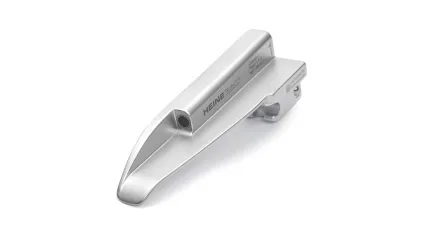
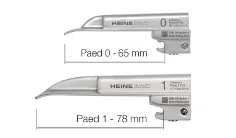
With the HEINE Classic+ Paed blade, you don’t have to choose between the two options. This blade is a highly flexible alternative with a special design: a relatively straight blade with a broad tip that distributes pressure evenly.
This helps avoid the unexpected need to switch blade types during intubation. It ensures quick and flexible intubation, reducing the time to successful lung ventilation and thereby lowering the risk of hypoxia.
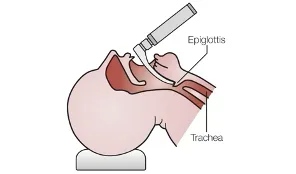
1. Straight Miller blade
When using Miller blades for intubation, the blade is placed under the epiglottis. The anesthesiologist then lifts the epiglottis by moving the laryngoscope toward the patient’s chest. This allows a full view of the vocal cords, trachea, and arytenoid cartilage.
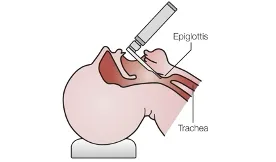
2. Curved Macintosh blade
When intubating with Macintosh blades, the tip of the blade is pressed directly into the vallecula. This lifts the epiglottis, exposing the vocal cords, trachea, and arytenoid cartilage.
3. HEINE Classic+ Paed blade
The HEINE Classic+ Paed blade is intuitive for both Macintosh users and those accustomed to straight (Miller) blades. It is suitable for both intubation techniques described above.
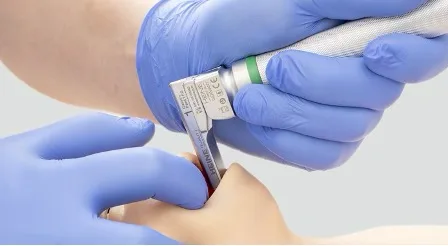

Oral endotracheal intubation is necessary to secure the airway but is technically very challenging. It places significant demands on users and the entire team. The high success rate of intubations directly affects the improvement of critically ill patients’ conditions. This applies to both oral and nasal intubation.
Therefore, proper technique, regular training, and the resulting experience are crucial. Equally important, however, is the choice of instruments, which can significantly contribute to successful intubation under difficult conditions.
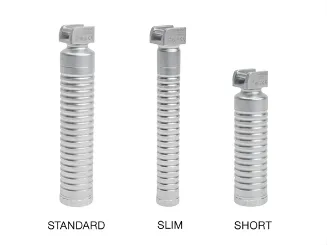
The ease, speed, and complication-free nature of intubation are influenced not only by the choice of different blade types but also by the different shapes of laryngoscope handles.
The following recommendations for using different handle shapes are intended to give physicians a general idea of which handles are better suited to certain situations.
The slim handle is well suited for intubation in restricted spaces caused by a protruding chest or a large occiput with a short neck, as in sensitive pediatric airways.
In standard adult intubation, the user usually grips the standard handle with the entire left hand to apply the necessary force by pulling ventrally. In children, however, finer motor skills are required, and the available space is significantly limited. Levering or repositioning the laryngoscope due to restricted conditions must be avoided.

Thanks to its narrow and lightweight design, this handle can be held with 2–3 fingers and is very easy to use. At the same time, the user maintains the fine control necessary for adjusting the laryngoscope’s position.
The slim laryngoscope handle weighs significantly less than the standard model. The reduced weight is beneficial when working with pediatric airways, as it helps minimize complications and subsequent tissue trauma more quickly.
In pediatric patients, the head is positioned differently than in adults - usually in the sniffing position (neutral). In this position, maneuvering space for the laryngoscope handle is smaller than with an adult chest. This means that when inserting the handle into the mouth, it may hit the chest.
The slim handle has about one-third less circumference than the standard handle, offering greater maneuverability.
The slim handle is not only particularly useful for treating children but also provides clear advantages for users with small hands.
Due to its reduced circumference, the slim handle fits small palms better than the wider, heavier standard handle. It can also be used for adult intubation.
For adults, the improved Jackson position is usually used. However, even with higher head extension, some patients with prominent chests may make laryngoscope insertion more difficult: the handle may touch anatomical areas, limiting maneuverability.
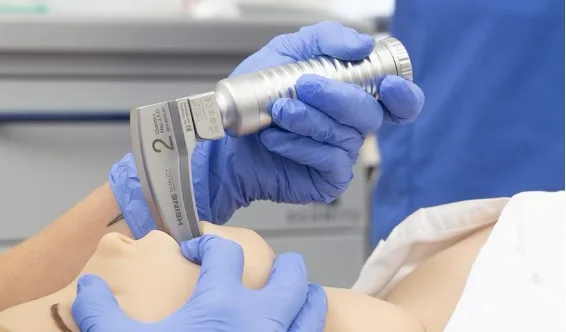
The short handle can demonstrate its advantages with this patient group. The shorter design allows easier positioning even with a prominent chest.
At the same time, the larger diameter provides a good sense of control.
With its compact design, the short laryngoscope handle combines the main features of the standard handle with space and weight savings. This is especially useful in mobile applications where life-saving equipment must be light, convenient, and compact, such as in-hospital emergency teams, rescue services, or special scenarios like mountain rescue.
The standard handle, recognized worldwide, has proven itself in classic intubation use.
The standard handle accommodates higher-capacity batteries, effectively doubling battery life. This makes the standard laryngoscope handle especially reliable for routine daily use.
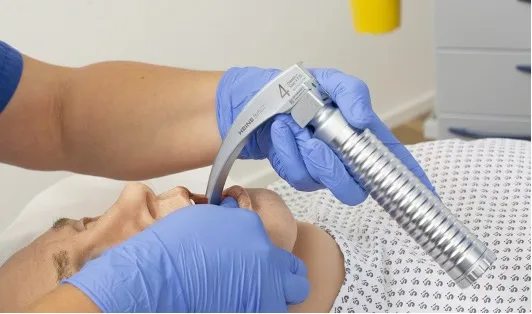
In some situations, additional effort may be required to align the visual axis with the vocal cords, which must then be maintained until the endotracheal tube is successfully inserted.
In such cases, it may be helpful for an assistant to hold the top end of the handle at the intubator’s direction and provide targeted support while guiding or lifting the laryngoscope.
Since different handles can facilitate intubation depending on the situation, it makes sense to have various handles available whenever possible.
The tips above are suggestions compiled through consultations with anesthesiologists. They are not direct recommendations. The choice of suitable instruments always and exclusively remains at the discretion of the qualified user.
Technically, intubation with direct laryngoscopy involves inserting the blade into the oral cavity.
The standard and well-established technique with curved blades is to insert the laryngoscope into the right corner of the patient’s mouth.
When rotating the laryngoscope handle medially, the tongue should be displaced by the blade. This movement may be complicated by the patient’s own and/or positional factors, as well as other simultaneous measures that need to be taken.
The vallecula and glottis, as well as the vocal cords and arytenoid cartilage, then need to be visualized. Depending on the patient and situation, not only the blade shape but also the choice of handle (slim, short, or standard) can be helpful.
TTT HealthCare, HEINE’s primary partner in the countries of the former Soviet Union, organised a two-day educational programme at the HEINE Optotechnik manufacturing facility in Gilching (Munich, Germ
The catalog on the website has already been updated.
The catalog on the website has already been updated.
Product successfully added to cart
Go to cart