
- Catalog
- Services
- About company
- For customers
- Blog
- Contacts
Language and delivery country
English · United States
HEINE has introduced a new dermatoscope model — DELTA 30 UV, expanding the capabilities of dermoscopy.
In this article, we will look at the key features of the HEINE DELTA 30 UV dermatoscope: why the ultraviolet version was introduced, how the device is designed, and what capabilities it offers in clinical practice. You will learn how the combination of different illumination modes works and what role it plays in the diagnosis of skin lesions.
The introduction of HEINE DELTA 30 UV is driven not only by market demand but also by the accumulation of clinical data on ultraviolet dermoscopy. A systematic review of ultraviolet dermoscopy shows that UV mode complements standard dermoscopy by enabling the detection of fluorescence, pigmentation features, and signs of infectious and inflammatory conditions that may be less visible under conventional light.
Individual studies also confirm the practical value of this approach. For example, the study “Ultraviolet Fluorescence Dermoscopy Improves Differential Diagnosis in General Dermatology” demonstrates that UV dermoscopy improves differential diagnosis in a number of dermatoses where standard polarized dermoscopy may be insufficient. Another study on scabies highlights that the best results are achieved when combining UV and polarized modes.
At the same time, ultraviolet light is not just an additional illumination source but a different visualization principle: it creates an image based on fluorescence, adding an extra diagnostic layer.
The concept behind HEINE DELTA 30 UV is to combine non-polarized, polarized, and ultraviolet illumination in a single device. This approach reflects modern clinical practice described in the literature: not replacing one method with another, but combining them. The physician can sequentially evaluate structure, surface, and fluorescence characteristics within a single examination.
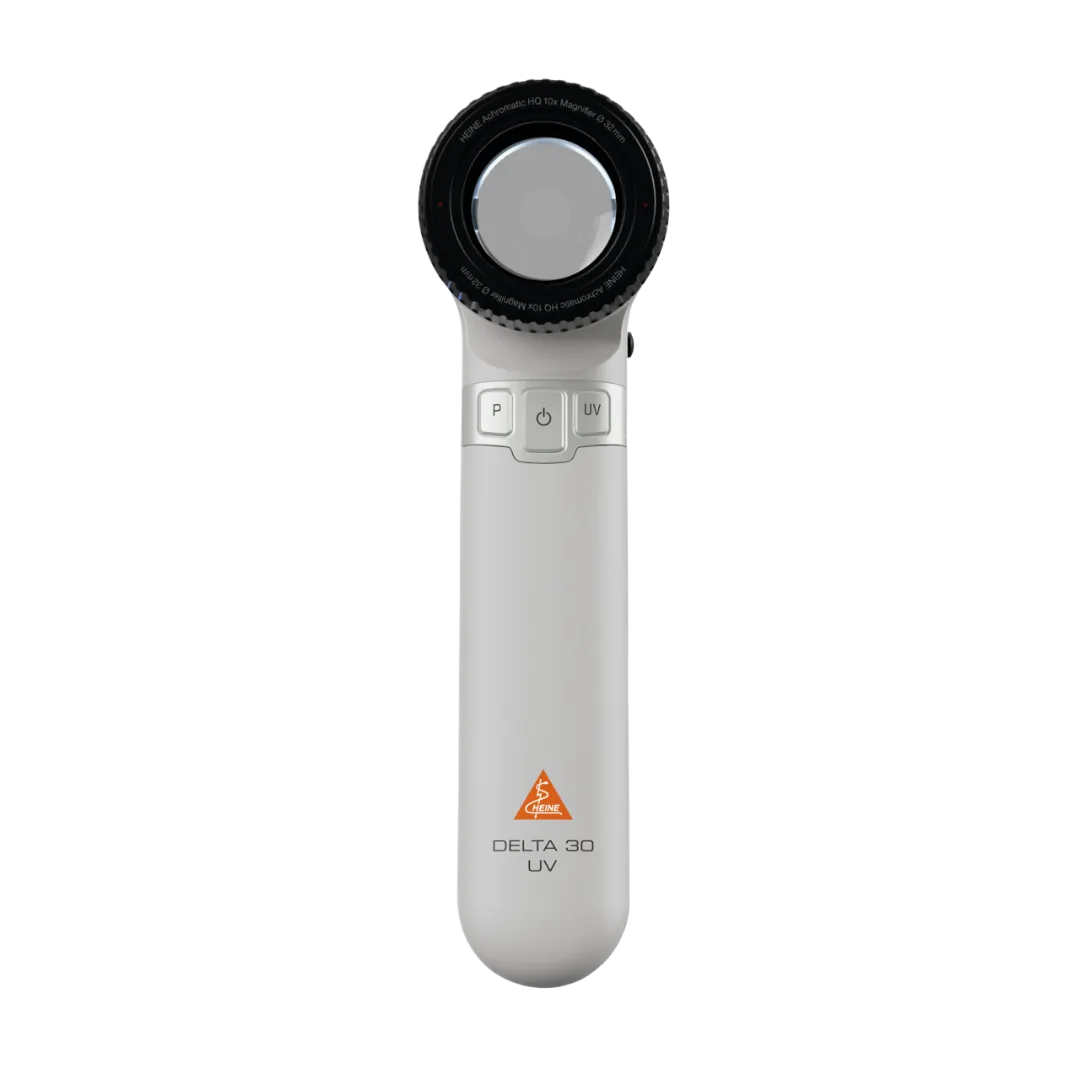 HEINE DELTA 30 UV
in catalog
The standard package includes:
The device is designed in a new color, making it easy to distinguish from other models in the series.
The optical system of HEINE DELTA 30 UV is identical to that of DELTA 30 PRO. The device features a 30 mm lens, a wide field of view, a large eye-box, and low optical distortion.
The control system remains the same as in the DELTA 30 series. On one side, there is a switch for polarized and non-polarized light with a quick toggle function; on the other side, a dedicated button activates the ultraviolet mode.
A brightness control button is also available, offering three levels for both visible and UV light. The interface is simple and intuitive.
The light color in HEINE DELTA 30 UV differs from the standard DELTA 30: it is more neutral (whiter) and provides higher contrast, making it easier to observe skin structures.
The device uses a cross-polarization system, allowing improved visualization of shiny white lines, structures, and polarization artifacts. Switching is performed between light sources with and without a filter.
The ultraviolet mode is activated with a single button. Once activated, the device functions similarly to a Wood’s lamp. Under UV illumination, fluorescence can be observed, with different materials and skin structures producing different colors.
The device can also be used in contact mode for standard diagnostics.

The main advantage of the device is improved workflow comfort. In standard practice, physicians often need two devices: a dermatoscope and a Wood’s lamp. HEINE DELTA 30 UV combines these functions into one instrument.
The ultraviolet mode does not provide more information than visible light but allows the same structures to be seen differently, which can simplify diagnosis, especially for less experienced users.
Practical Example
In scabies diagnostics, under visible light the mite may appear as a dark brown triangle, while under ultraviolet light it appears as a neon green triangle. This makes detection faster and more intuitive.
In dermatology, different diagnostic approaches focus on different features of skin lesions. HEINE DELTA 30 UV is designed with these differences in mind and allows physicians to work within their preferred diagnostic framework.
In the European school (notably in Germany and Austria), the focus is on color, asymmetry, and pigment distribution. Color helps assess the depth of melanin: black indicates superficial placement, while gray or blue suggests deeper layers. The deeper the pigment, the higher the risk, as the likelihood of spread through blood and lymphatic systems increases.
In the Australian and American schools, more attention is given to polarization structures, such as shiny white lines. These can be observed in conditions like basal cell carcinoma or melanoma and serve as important diagnostic indicators. Their presence may indicate a more advanced stage and influence treatment decisions.
HEINE DELTA 30 UV supports both approaches. Visible light remains the primary tool for evaluating color, while polarization highlights structural features. The ultraviolet mode serves as an additional diagnostic channel, offering a different visualization of the same structures and facilitating interpretation.
Thus, the device does not replace existing diagnostic methods but complements them, providing more options for analysis and decision-making.
What is the difference between DELTA 30 PRO and DELTA 30 UV?
DELTA 30 PRO provides illumination that closely matches natural sunlight, making it easier to evaluate lesion colors. This is particularly important when assessing pigment depth.
DELTA 30 UV, on the other hand, uses a more neutral white light with higher contrast, improving visualization of polarization structures. It also includes an ultraviolet mode that allows the same structures to be viewed in a different spectrum.
These models do not replace each other but complement each other, allowing physicians to choose based on their diagnostic approach.
Does the optical quality differ from DELTA 30 PRO?
The optical system in HEINE DELTA 30 UV is identical to that of DELTA 30 PRO. At present, further improvements are not possible, as the optics have already been designed using highly advanced mathematical models.
The design ensures a clear image even when viewed at an angle, which is important in practice, as physicians cannot always hold the device perfectly perpendicular to the skin.
Is the device compatible with DELTA 30 accessories?
in catalog
HEINE DELTA 30 UV is fully compatible with standard DELTA 30 accessories, including desktop charging stations, USB-C charging, contact plates, small contact plates, and distance spacers.
Why are there no multiple color temperature options?
Adding additional color modes would significantly complicate the electronics. Moreover, ultraviolet mode is not required by all users, so classic models remain relevant.
Visible light remains the gold standard for color evaluation, while UV alters color perception. Therefore, DELTA 30 PRO and DELTA 30 UV complement each other rather than replace one another.
How should the device be cleaned?
The device can be cleaned using alcohol or standard disinfectant wipes. Different types of contamination may require different cleaning agents.
If heavily soiled over time, individual plastic components can be replaced, which takes only a few minutes.
Can plastic parts of the housing be replaced?
Yes, individual plastic components can be replaced. The process is straightforward and does not require complex procedures.
However, these parts are not standard spare parts for general ordering and are typically replaced through service support.
HEINE DELTA 30 UV is expected to be available from mid-April 2026. Prior to launch, the device will be presented at key industry events, including the AID conference in Denmark and the American Dermoscopy Meeting.
Pre-orders will also be available.
The price will be at the same level as HEINE DELTA 30 PRO. No price increase is planned.
In this article, we explored the key features of the HEINE DELTA 30 UV and its role in modern dermoscopic practice. The device combines multiple illumination modes and complements standard dermoscopy by offering a different way to visualize familiar structures.
HEINE DELTA 30 UV will soon be available. If you have any questions about the device or its application, feel free to contact us — we will be happy to help.
TTT HealthCare, HEINE’s primary partner in the countries of the former Soviet Union, organised a two-day educational programme at the HEINE Optotechnik manufacturing facility in Gilching (Munich, Germ
The catalog on the website has already been updated.
The catalog on the website has already been updated.
Product successfully added to cart
Go to cart